Many questions arise when you are approaching life in retirement. We help you make decisions that fit your plans. We live longer and we are more active when we retire than previous generation. The more you have prepared for your retirement life, the better it will be. It is therefore a good idea to consider your retirement well in advance.
Generally, you will need about 80% of your final salary when you retire, as you save about 20% when you no longer make pension contributions, pay membership fee to an unemployment insurance fund, etc. Apart from that, your financial needs will often not change much.
Are you planning to retire within the next three years? Book a meeting – and we will help you make a pension plan that prioritises your wishes, so that you get the most out of your savings.
Today, most people can expect to live more than 20 years in retirement. What should you be aware of in this connection and how can you spend these many years?
Society prefers you to work for as long as possible. You will therefore get a number of
advantages if you postpone your retirement, such as a higher early retirement benefit rate, tax-exempt premium,
additional life-long supplement to state retirement pension, etc.
If you want to continue working
If you want to continue working, different rules apply depending on your age. You can learn more about the rules in
the linked fact sheets, targeting the different retirement ages.
Every year you postpone retirement, you earn an extra year's salary, and you also allow your pension savings to grow.
If you are not part of the early retirement scheme, partial pension might be an option, though this scheme is being phased out and will end by the close of 2025.
For more information about the state pension, you can read more here. If you want to know more about early retirement, you can read more here
Many factors can play a part when choosing where to live. It is always a good idea to consider whether you wish to remain in your current home when you retire or move to something else. In choosing this both health and economy are crucial. Moving from a house to an apartment is not always cheaper. Maybe it’s also hard to find the place you want to get old in. To meet the demand for rented housing, it might be a good idea to be written up in good time.
Senior life is lived locally. Your dwelling is the physical setting of
your life, a part of your finances and your home, which may carry memories from a long and good life. Your dwelling
should meet your needs on the day you retire, as you will spend far more time at home.
Financial support You may be eligible for benefits to help pay your housing expenses. Housing benefits are offered as a loan for
owner-occupied homes and co-operative housing units and as a subsidy for rental homes. You can calculate your
options at www.borger.dk.
Postpone taxation When you or your spouse receives early retirement benefits, supplementary early retirement benefits, part-time
retirement benefits, state retirement pension benefits or anticipatory pension benefits, or reaches the age of 65,
you may have the option to freeze your property taxes.
Life expectancy is increasing for both men and women. Most people can expect to live 25-30 years after they have left the labour market. Therefore you must have a good pension savings plan.
For quite some time, the trend has been that we live longer, and the indication is that this will continue. 20 years
ago, the average life expectancy for Danes was 72 years for men and 78 years for women, respectively. Today, the
average age for men is 77 years and for women 82 years.
While we should enjoy the prospect of living longer, we should also remember that a long life leads to greater
demands on our pension savings, as most people will need their savings to be paid out over a longer period of time.
Clearly, many different factors influence your life expectancy, such as genetics, your choice of career and your
lifestyle.
Naturally, how much we need is individual. Danica recommends that you have 80% of your previous income
when you retire, and that the majority of your savings are paid out as life-long benefits. But it is far from
certain that this fits your needs. If your lifestyle differs from most people’s, you should consider what is most
suitable for you – what it will cost you, or what you will save. When making your budget, you should remember that your spending is more than just your fixed expenses and grocery shopping. Maybe you have a hobby you want to focus more on, you want to travel more or you want more household and gardening help.
Think ahead
Maybe you also want to actively participate in society when you retire. Then you should consider ensuring that your
financial needs are not only inflation-proofed but that they are also adjusted for the cost of living. New
things happen all the time. New technology, new travel destinations, new housing standard demands, etc. And just
like when you were young, you do not want to live like your parents, but like everybody else. A cost-of-living
adjustment of 1.5% and inflation adjustment of 2.5% are realistic.
It may seem a long way into the future, but after many good years in retirement, extra assistance in the home may be needed. Therefore it may be a good idea to keep the budget at an unchanged level.
It gives you the freedom to decide yourself. When we reach a certain age, everyone does not necessarily think that it is enough to get help, for example, to go to the bath once a week, and therefore they buy help. Some may choose to get private help for cleaning and gardening, as well as having food delivered for family reunions.
Obviously, the need for help is individual, but also what the economy leaves room for.
It is completely up to you who is to receive your pension savings when you die. Appointing who is to receive your
savings is also known as designating your beneficiary.
Generally, your next of kin will receive your savings. However, you can decide to designate other persons than your
next of kin. In that case, you must notify us in writing.
The Danish Inheritance Act is complex, and many people would benefit from drawing up a will. This can be an
advantage, for example if you and your spouse want to secure each other financially in case of death. If you need
legal advice, we recommend you to contact a family law specialist.
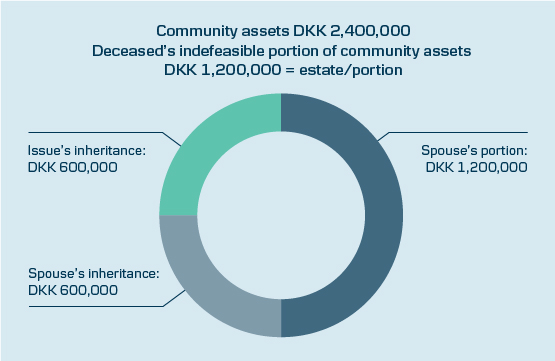
Who is to inherit your assets? If you are survived by a spouse and/or children or grandchildren, your assets will, as
a general rule, be distributed in equal shares between your spouse (50%) and your children or grandchildren (50%).
Distribution of your remaining assets according to the provisions of the Danish Inheritance Act
Do you prefer another distribution?
If you want your assets to be distributed differently, you need to consult an attorney and draw up a will. In many
cases, you can designate specific persons on your pension scheme outside the rules of the Danish Inheritance Act.
Keep in mind, however, that if you have a spouse and/or children or grandchildren, at least 25% of your estate must
be inherited by them. This means that you can leave 75% of your estate by will – and your entire estate if you leave
no beneficiaries entitled to an indefeasible portion of your estate.
You can see the designated beneficiary of your pension scheme in Netpension, where you can also change your designation if you want to do so.
You can learn more about next of kin and designation of beneficiaries here.
Pensions can be a confusing topic and an area full of rules. Therefore, we recommend that you seek professional advice to secure your future finances. It can have a great impact on how on the planning of the third and fourth ages.
Need advice? Our advisers are ready to hold a free meeting with you one year before you retire.
We use data from our own and 3rd party cookies to remember your settings, traffic monitoring, improvement of our services and to send you relevant marketing information. For these purposes we profile you based on the collected data and on 3rd data collected from our partners. By navigating on our website you consent to our use of cookies. You may read more about our use of cookies here. If you reject cookies you must click here and we will not set cookies except required for site functionalities. You may always revoke your consent for our use of personal data for profiling and direct marketing as stated here.
Content is loading
Show
Hide
Show more rows: All table rows are already visible for screen readers.
Show less rows: All table rows are already visible for screen readers.